This is the richest collection of African sculpture I have ever seen - even though it contains not a single royal bronze from Benin despite it’s focus on West Africa. It is also expertly lit and labeled.
What's problematic is the stated attempt to "
decolonize the Western aesthetic standards long placed on these objects and to elevate the local indigenous perspectives of the works’ makers and communities. "
Gallery text tells us the local African words for various aesthetic qualities — but the eye that selected all the examples is European - as is the furniture, lighting, and text that presents them. "Virtue signaling" refers to speech whose primary content appears to be the virtue of the speaker. Isn’t that what is happening here?
Far from being "decolonized", traditional Western aesthetic standards are on full display. Perhaps that is not such a bad thing if we allow that Western eyes (or, at least some of them) can appreciate whatever visual quality some African eyes once demanded back when these pieces were made. A hundred years ago that kind of elitist universalism, as exemplified by Andre Malraux, was mainstream. Today, however, we may note how important it is to conceal it.

Ngbandi ?, Congo, Ubangi District, 19th to early 20th
This is my favorite piece in the show.
No sense of the divine here - just an ordinary man ready to do his bit.
I’d call it "humanism"
Some pre-Heian Japanese carvings have a similar, simple power.
The Ngbandi people of the upper Ubangi River ( Congo) may have had a great tradition in wood carving - or maybe not. The Belgians who originally collected these pieces could only guess at the origin of these carvings. Wikipedia tells a rather grim story of how the Ngbandi were treated by the Belgian government in the late 19th century.
Similar, and excellent, examples are occasionally offered for sale online, and some were recently donated to the
Cleveland Museum of Art
The style is echoed by a contemporary sculpture shown below -
though with a political purpose and a pathetic effect:
Theaster Gates, Richard Gray Gallery
Lega people, Iginga figure, late 19th, early 20th C.
Another one of my favorites.
Cute in content but not in form.
Lega
Another ethnic group now in the Peoples Republic of Congo,
though on the opposite side of the country.
…figurines were usually displayed only during initiations into the highest level of the men only Bwami association. Associated with proverbs and serving as memory aids, such sculptures were also sacred objects, Their weight of significance comes through in the label for them as "heavy things” …. , An intrinsic transcendental force gives all Bwame objects the power to heal or harm. If no other medical remedy could prove effective, particles taken from a wooden or ivory figurine, typically by scraping or rubbing its surface with sandpaper like leaves, would be mixed with water and given to a person to drink.
(Note: text in orange comes from gallery signage)
Luba - Staff of Office (kibango), 19th c.
Staffs like this one are always the property of kings, chiefs, diviners, dignitaries, or other titleholders. A newly appointed chief would hold a staff in one hand as he swore his oath of office. Read from top to bottom, it also functioned as a chronicle legitimizing its owner's anthority. The iron point and the copper wrapped around its shaft signal wealth and stability. A staff also acquired supernatural qualities and powers when medicines were inserted into the hairstyle of the figure on its crowning finial, enabling the sculpture to cure and protect its owner and those under his influence.
The Luba were from southwest Congo. They were developing an empire and metal technology when their budding civilization was destroyed by Belgian and Arab raiders.
Perhaps this is the time to note how many of these pieces were made in the Congo and how many of
them come from Belgian collections. The curator is a Belgian himself - perhaps explaining both his interest and access to this work.
(BTW - one of my earliest sculptures was a 3-D map of the Belgian Congo, age 9)
We might also note that almost everything in this exhibit dates to the era of European colonization. Earlier pieces could not survive the tropical climate while later pieces are considered less authentic on the art market . Having destroyed native social and political structures, the invaders then determined that everything made thereafter was worthless.
The need to comprehend "indigenous perspectives" is the same demand for "authenticity’ that sophisticated European collectors have always had for African art. If it was made to sell to people like them , they give it less value.
Not surprisingly - the Brong (or Bono) people are matrilineal.

Chokwe, Angola
Usually
identified as a representation of the Chokwe mythological hero Chibinda
Ilunga, this sculpture is in the same style and possibly by the same
artist as the other male figure displayed nearby. He holds a staff and
medicine horn that represent the equipment used during hunting, evoking
the endurance and masculine power needed during an expedition. Its
dynamic energy is conveyed through anatomical details including a
muscular body, flexed arms and legs, and large hands and feet. Exuding
both political and religious authority, such figures would have been
part of an altar and served to fight off physical as well metaphysical
threats.
Chokwe
The sculptural art of the Chokwe people has long been renowned for its refinement. Western collectors and scholars have particularly appreciated these works' naturalism--for instance, the figure of the mythological hero Chibinda Ilunga shown nearby has been praised for its graceful and meticulous carving. The Chokwe people, however, use a specific term to describe a sculpture executed with skill and care: utotombo. It identifies a crucial aspect of cibema, a word that corresponds, in English, to both "beautiful" and "good" and may be used to praise a work. This language is also applied to masks depicting young women with elaborate hairstyles and jewelry that express their good taste and wealth as well as to figures of male leaders whose powers ensure a community's survival.
Probably a Kulebele workshop
Senufo: Senambele
Côte d'Ivoire
Mother-and-Child Figure
19th to early 20th century
This majestic figure was most likely used as a stationary display piece for the Poro association, a Senufo organization that brings together men of different age groups in order to promote their social and political authority. The association also serves as a religious institution that educates both genders. This image refers to the character known as Kaatyeleo, or Ancient Mother, the central deity of the Poro initiation process: she guards and instructs the young men entering the association as her children, nursing them with the milk of knowledge, The figures that evoke her are said to express glam, mature authoritative power.
While sometimes thought of as a lower caste in Senufo society, the Kulebele have protection and prestige in their access to a group-specific supernatural power, the kafigeledjo. Feared and respected, the Kulebele are also thought to have the ability to turn into hyenas. Through the use or threat of these powers, the Kulebele maintain their specialized and exclusive role as woodcarvers.

Beyond its specific depiction of a mother nursing her child,
this sculpture symbolizes a larger concept of ancestral
motherhood that is central to Senufo society, in which
cultural inheritance is matrilineal. The darkened areas of
wood come from oils applied to its surface as both libations
and surface protectants. In some Senufo beliefs, one of the
most important founding ancestors is the Great Mother or
Ancient Woman (Katyeleeo or Maleeo). In groups that
believe in the Great Mother, she suckles male initiates with
the "milk of knowledge." Through this process, youths gain
the information they need to become adults (that is, fully
human). The simplified appearance of the "child" in this
sculpture reflects his unformed, pre-initiated state.
Above is the text on the website of the Cleveland Museum of Art.
Below is their photo of it,
Used to promote their 2015 exhibit of Senufo art.

Much of the African art collected by Europeans in the early 20th C. was Senufo - as evidenced by the 1963 exhibit "Senofo Sculpture from West Africa" - the first ever art museum exhibit to focus on just one particular people (BTW - it came to Chicago!) … and the following:
In a book on the subject, Robert Goldwate (director of the Museum of Primitive Art),juxtaposed American photographer Walker Evans’s 1935 print of a sculpture by an unnamed African artist with Pablo Picasso’s Nude of 1907. On the basis of form, Goldwater regarded the African sculpture as an example of Senufo art. His interest in African art, and Senufo art more specifically, led him to organize the influential Senufo sculpture exhibition when he was director of the MPA. Through the exhibition and its companion publication, Goldwater established enduring parameters of the Senufo style.

Studio of Andre Derain, 1910-11
Could not find the Picasso photo,
but according to Gertrude Stein,
Derain was into African art even earlier.
Looks like Derain had an excellent collection
The text below is quoted from Picasso's letter to Malraux:
“People often talk about the influence of African art on me. What can I say? We all liked fetishes. Van Gogh said, ‘We all had Japanese art in common.’ For us, it was the Africans. Their forms didn’t influence me more than they did Matisse. Or Derain. But for them, the masks were sculptures like any others. When Matisse showed me his first African head, he talked about Egyptian art.
“When I went to the Trocadéro, it was disgusting. Like the Flea Market. The odor. I was alone. I wanted to leave. But I didn’t. I stayed. I stayed. I understood that it was very important. Something was happening to me…
“The masks were not like other sculptures. Not at all. They were magical things. So why weren’t Egyptian or Chaldean sculptures magical? We didn’t realize: they were primitive, not magical. The African pieces were intercesseurs. Ever since then, I’ve known the word in French. They stood against everything, the whole; against the unknown, threatening spirits. I was always looking at fetishes. I understood; I too am against everything. I too believe that everything is unknown, that everything is an enemy! Everything as a whole! Not the details, women, children, animals, tobacco, playing, but everything together! I understood what the Africans used their sculpture for. Why sculpt like that and not some other way? After all, they were not Cubists! Cubism did not exist. It was clear that some fellows had invented the models, and others had imitated them. That’s tradition, isn’t it? But all the fetishes were for the same thing. They were weapons to help people avoid obeying the spirits so they could become free. Spirits, the unconscious – something that was not talked about much then – emotion: they were all the same thing. I understood why I was a painter.
“All alone in that dreadful museum, with the masks, the Redskin dolls, the dusty cloth figures. Les Demoiselles d’Avignon must have come to me that day, not at all because of the forms, but because it was to be my first exorcism painting!”
André Malraux, The Mirror of the Limbs – II. The Cord and the Mice, 1976.
Sounds like Picasso’s reaction to African carving was quite different from mine as well as the curator who wrote the text for the wall of this show. But I and the curator have been viewing and thinking about African art for many decades. We grew up with it being in the canon of great world art. Picasso is reporting on the very first time he, and many other Europeans, saw this kind of work - and as his biographies tell us, he was a bit closer to the dark side than I will ever be.
Mumuye, Nigeria
Kongo: Yombe
Probably Democratic Republic of the
Congo
Two-Headed Dog Figure
(Nkisi Nkondi Miwa or
Nkisi Kozo)
19th century
Wood, pigment, metal, and resin
A power figure in the form of an mbma (dog), like the two-headed exam-
ple shown here, draws strength from the animal's heightened senses in
order to serve as a more effective channel between the human world and
that of the spirits. Kongo hunting dogs navigate two earthly spheres-
village and forest- and therefore can also mediate between the living
and the dead. Just as a dog serves his owner by anticipating his move
ments through the wilderness while hunting, so does the akis akondi
mbira (especially a two-headed one) enhance the potency of an alia
nkondi by watching for dangers that might approach from any direction,
Northern We , Côte d'Ivoire
Face Mask (Tonhu Zri)
19th to early 20th century
Wood, pigment, and fiber
The We and neighboring peoples of Liberia and Cöte d'Ivoire
share a tradition of masks in which a human face has some features
doubled, others enlarged, and still others omitted entirely--all
combined with cavities and protrusions. Each was designed to be
part of a dynamic context of music, dance, and song. These works'
appearance and identity evolve over their lifetimes as animal and
other natural parts are added, increasing the masks' supernatural powers that are helpful in war and combat.
Ibibio (Anaang), Nigeria
Bamala, Mail, Head of a Hobby Horse, 20th century
Kindombolo, the mask of the clown or trickster, gives form to collective
ideas about ugliness and the grotesque through his outrageous perfor-
mance and ragged clothing. When he enters the dance floor, the crowd
grects him with insults; "You are ugly!" and "You are a slob!" The holes
on his cheeks represent the scars of smallpox as kindombolo portrays a
character who, having survived the disease, is oblivious to physical dan
ger and social etiquette. Parodying other masks and flirting with female
onlookers, he provides comic relief for the audience. His dance is marked
by vulgar behavior and sexual innuendo.
Igbo
Nigeria
Half-Helmet Mask
(Agbogbo Mino)
Early 20th century
Wood and pigment
Light in color, with small, delicately balanced features, the aghogho
mmo (maiden spirit) mask shown here glorifies women but is activated
in performance by men. They wear elaborate coordinating costumes,
as documented in the photograph at right, taken in the Awka region of
Nigerin in the mid- 1930s. The mask's appearance represents spiritualized, idealized grace, beauty, and purity -in Igbo terms, Okoroshi uma,
or "good-pretty." Its hairstyle is modeled after one that was popular
for marringeable girls from the Inte 19th century, which incorporated
buttons and ornamental combs, The chalky substance and swirling patterns on the face represent the geometric body decorations painted on
Igbo women, known as uli designs.
Kongo: Yombe
Angola, Cabinda, or Democratic
Republic of the Congo
Male Figure (Nkisi Nkondi:
Mangaaka)
19th century
Wood, pigment, iron, ceramic, fiber, textile,
and glass
The Kongo would recognize this power figure, an example of nkisi nkondi,
as having the potential to be animated by physical and metaphysical
forces. Its bright white eyes and reflective mirror (on the stomach)
act as a threshold to spiritual realms. The features allow the figure to
"see through" any living person and also reflect evil back toward itself.
Among the Kongo the dramatic combination of compelling beauty and
repulsion (created by the addition of nails and natural materials) would
be called ngitukulu, which might be understood as "awesome.
(I’m showing the back view, not only because it is more powerful, but also because I didn’t want my evil energy reflected back at me by the mirror on his stomach)
Songye, Democratic Republic of the Congo
Male Figure (Nkishi)
19th century
Wood, pigment, copper, brass, iron,
antelope horn, animal hair, raffia cloth,
and glass beads
Because this power figure displays a high level of craftsmanship as well
as elaborate paraphernalia including an antelope horn, metal sheeting,
and glass beads, we can infer that it was the collective property of a vil-
lage and served a community. Anyone could make a figure for personal
use. Community figures, however, were made by recognized special-
ist carvers and then empowered and accessorized by reputable healers
known locally as banganga (sing, nganga). Community mankishi (sing.
nkishi) were typically kept out of sight in a sanctuary, but their reputa-
tions would still extend beyond their immediate vicinity. These works
served successive generations while personal figures would be discarded
once they accomplished the goal they were designed for.
Songye
Democratic Republic of the Congo
Mask (Kifwebe)
19th to early 20th century
Wood and pigment
Bifwebe (sing, kifwebe) masks depicting strange beings--neither
human, animal, nor spirit- were visual ambassadors for a variety
of masking societies in Songye and Luba regions. The size of
the crest on top reflects a mask's magical potential and mystical
power. Male bifinebe (such as the one shown here) are covered in
colored stripes. Female versions are mostly white and associated
with goodness, purity, and beauty, which they can use to engage
benevolent spirits. Bifirebe served as tools for entertainment,
social and political control, or religious protection against sorcery.
The Songye claim these forms have Luba origins, while the Luba
assert the reverse -an appropriately ambiguous backstory for the
strange kifirebe character.
Luba, Democratic Republic of Congo, Female Figure (Nkisbi), 19th Century
Guro, Ivory Coast, 19th to early 20th C.
Lele (possibly), Ceremonial Adze, Democratic Republic of Congo, 19th C.
Southern Dan, Liberia , Face Mask (Bugle)
20th century
Wood and pigment
Though the meaning of a Dan mask sculpture usually cannot be
determined without its companion costume and dance choreography
there are some notable exceptions, including this Liberian example the
so-called War Mask (or Gun Mask) character known as buple. Intended
to accompany and protect warriors in battle, it represents an imposing
male persona with an aggressive and violent demeanor, an indicated by
the row of small antelope horns carved above its face, the protruding
shape of its eyes, and its wide-open, projecting animal mouth, le would
have been complemented by a bulky, black fenther headdress
Dan masks are one of the collectible genres of African art
- above are two examples pulled off the internet.
One, undated, sold at Sotheby’s for $7000.
The other, from a contemporary workshop, is now being offered online for $98.
Care to guess which is which ?
I would say that they are both authentic,
but one feels more superficial.
Mbala
Demperatic Repubile of the Congo
Mother-and-Child Figure
(Gibalu Gimenyi)
19th to earlv 20th cemtury
Wood and pigment
This figure wearing the lobed pentoty wig, and carrying her little boy on
her kip would have formed a couple with s male counterpart, often a
drummer. Following the ritals marking a new chief's ascent to power,
these types of figures took thels place among other sacred objects in the
ruler's house. They also served as quardians of the commumity's well
being and women's fertility. They received regular offerings of palm
wine and blond from sacrificil animals as a tribute to the ancestors
Bamana, Mali, Helmet, 19th to early 20th
Bamana, Mali, Female Headdress
Bamana
Possibly Segou region, Mali
Mounted on a base designed by Kichizò
Inagaki (Japanese, 1876-1951)
Puppet in the Shape of a
Female Bust (Yayoroba)
19th century
Wood, pigment, and glass
Puppet masquerades for entertainment, known as sogo bo, are overseen
by Bamana youth associations called Kamalen Ton. Yaporoba, represented by this female bust, is one of the characters at the center of a
series of up to 20 performances comprising a sogo bo. In order to cul-
tivate moral values and social etiquette, the event typically combines
humor with education. Each masquerade is accompanied by drumming
and a chorus of men and women, with a lead singer. Yayoroba embodies
beauty, grace, and dignity but also exemplary character and impeccable
conduct. The Bamana refer to this combination of ideal physical and
moral qualities as sara- "divine beauty.
Bamana
Mali
Female Figure (Nyeleni or
Jongeleni)
19th to early 20th century
Wood, pigment, copper, metal, and beads
Detroit Institute of Arts.
Adorned with nose piercings, earrings, and anklets, jonyeleni figures
represent Bamana ideals ofbeauty and morality combined, qualities that
a young woman is expected to cultivate to become ready for marriage.
In the context of the Jo association, an organization that teaches male
and female youths how to be productive adult members of society, such
figures also express the desire of male initiates to find a partner and start
a family. On a woman, a strong neck is a sign of honesty and integrity
and firm breasts attest to her ability to carry and nourish offspring. The
geometric body designs on the adjacent figure imitate scarifications that
enhance female anatomy.
The text elaborates on the relevant social customs.
Fang: Ngumba
Cameroon
Reliquary Guardian Figure
(Eyema Byeri)
19th century
Wood, pigment, brass, and teeth
In its original context among the northern Fang, this sculpture would
have been adorned with an elaborate hairstyle decorated with brilliant
red feathers from the African gray parrot. Human teeth inserted into
the eye cavities and carved wooden teeth in its mouth give the figure a
menacing demeanor and reinforce its function as a guardian of ancestral
relics, The pronounced eyes convey its extended vision and ability to
detect natural and supernatural threats, while the carved animal horn
imitates a receptacle for protective medicinal substances,
Bamileke
Bandjoun Kingdom, Cameroon
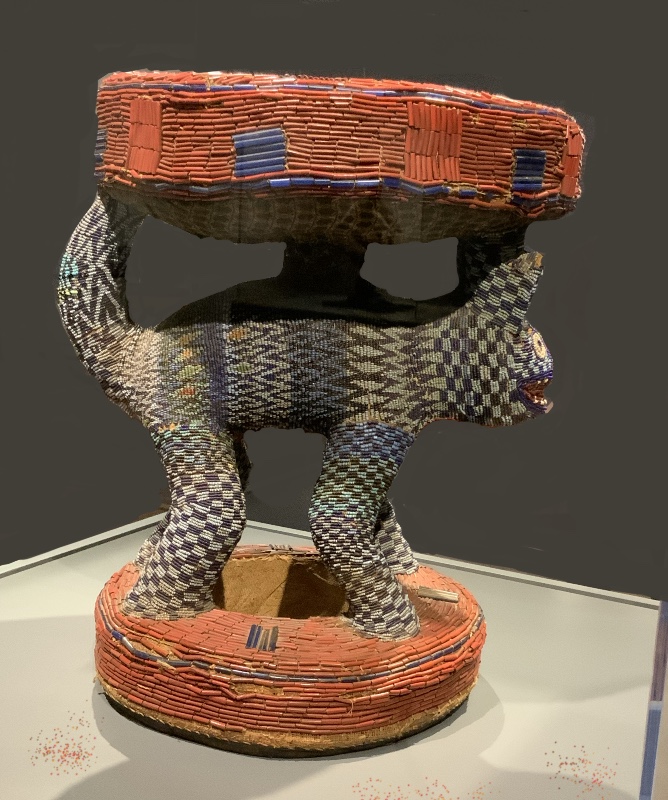
Prestige Stool (Kuo)
Possibly 19th century
Wood, cotton, fiber, glass beads,
and pigment
The Cleveland Museum of Art,
This stool once be longed to the 12th king of Bandjoun, Kamga Il Joseph,
of the Bamileke people, who is pictured at right with his attendants in
front of his palace. The photograph was taken in the first years of his
prosperous reign from 1925 to 1975. The stool was probably carried
along whenever the king left his residence to greet dignitaries or to
attend public events and state ceremonies. The leopard connotes beauty,
strength, and wisdom but also refers to the ruler's ability to transform
himself into a leopard at night in order to guard his kingdom. The
colorful glass beads covering the stool were imported from Venice and
Bohemia and were a highly valued commodity reserved for the king and
his entourage,
Northern Nguni: probably Zulu
South Africa
Headrest
19th century
Wood and pigment
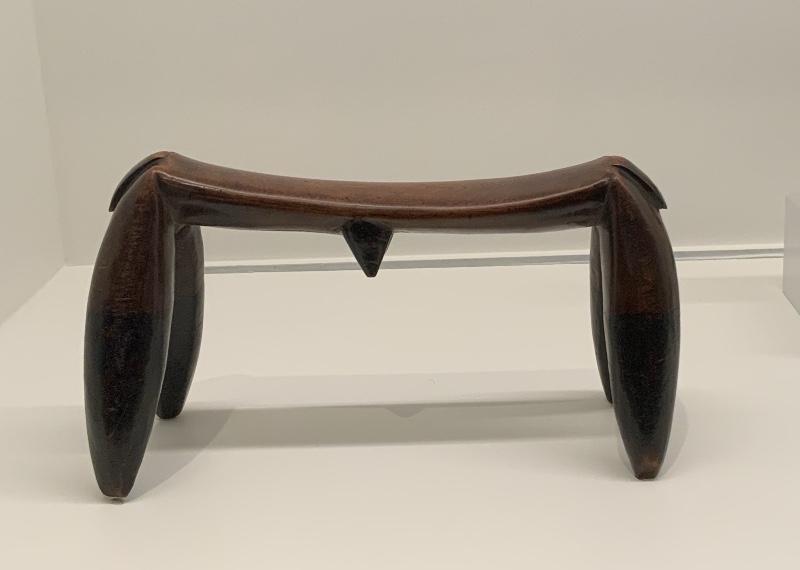
In their most basic function, headrests like those in this case are wooden
pillows, used by some men and women to protect elaborate hairstyles
during sleep- as in the photograph at right, taken in South Africa in
the early 20th century, of a Zulu woman (with her nursing child) . These
objects also serve as expressions of social and cultural beliefs all over
Africa, especially in southern and eastern regions. Cattle are so highly
valued among the Nguni people, serving as symbols of prosperity, that
carvers often incorporate four legs and other bovine forms to effciently
represent the animals or to flaunt high status and wealth. Headrests are passed down through generations and help to connect each owner with
ancestors and spiritual forces, often through dreams
Unidentified culture
Possibly Benue River Region, Nigeria
Male Figure
Possibly 19th century,
Copper alloy
Although its cultural and geographic origins are unknown to us, this
unique figure's scale and the care taken to create it as well as the material
used suggest that it was associated with prestige and authority, whether
secular or sacred, Similar metal sculptures were observed in the 1970s
and '80s in the Benue River Valley region along the Nigeria- Cameroon
border and may have been part of a shrine dedicated to a guardian deity.
Southern Nguni; South Africa, or
Southern Sotho;
Lesotho
Pipe
19th century
Wood, pigment, and iron
The missing stopper of this pipe, delicately shaped like a female figure,
was probably a carved head. A pipe this carefully made would have been
inherited within a family or descendant group, for use by either a man or
a woman. Its design and craftsmanship honor its role in fostering connections with ancestors as well as the cultural expectation that tobacco
should be generously shared. In southern African, both smoking and
snuffing tobacco were often associated with promoting fertility and
procreation, in addition to serving social and leisure functions.
Kota: Mindumu
Gabon
Reliquary Guardian Figure
(Mbulu Ngulu)
19th century
Wood, copper, and brass
This sculptural form shows a dynamic interplay between abstraction
and realism. Its skull-shaped head likely impressed its original viewers
and called attention to the potent ancestral remains it guarded, pre
served within a basket or bark receptacle. In the 20th century, Western
visitors found it comparatively easy to purchase such figures from their
Kota owners, who would not consider parting with the containers be-
cause the sacred contents served as a gateway to the ancestors.
Bamileke: Batoufam Kingdom
Cameroon
Portrait of a Queen
(Wife of King Njike)
Early 20th century
Wood and pigment
Collection of Jan Calmern, Sint-Niklaas, Belgium
The bold facial expression of this mother carrying a child
would probably have appealed to artists of the German
Expressionist movement, who aspired to render human emo-
tons with raw intensity, They became interested in African
art forms around the early 1900s. This work was previously
part of a set of commemorative portrait figures representing
six generations of royal spouses that were arranged in front
of the king's palace at Batoufam. It can be seen as part of that
grouping in the photograph at right, taken in the 1920s-
just to the left of the entrance. Carved to mark the enthrone-
ment of each king and queen, such sculptures honored the
new rulers as guardians of the well-being of their land and
people. The portrait of King Metang, the tenth sovereign of
Batoufam (the second figure to the right of the entrance), is
on view in the Arts of Africa, Gallery 137.
Probably a Fonobele workshop
Senufo: Senambele
Côte d'Ivoire
Male and Female
Paired Figures
19th to early 20th century
Wood and pigment
This imposing pair refers to the first human couple conceived by the
Senufo creator god, Kolotyolo. They celebrate the enduring beauty
of the primordial man and woman and honor the ideal balance
between genders. The figures likely once held rattles and fly whisks
(tools for waving off insects) in their hands; these are emblems of
the Senufo initiation association for men called Poro. The male's
circular crest with an openwork, lizard-shaped design is also one of
Poro's attributes. The pair was prominently displayed- originally
colored with red and white -near the sinzanga, or sacred sanctuary
of the society, during the funeral of a distinguished member.
As the above gallery text tells us, this couple was painted red and white when used in a funeral. The bare wood, the supporting pins in the ankles, and the dramatic lighting was all done for art loving Europeans.
Unlike that 1963 exhibit that confined itself to Senufo art,
this signage offers generalizations about sub-Saharan African art.
Though I can’t see how any of the four qualities other than "youthfulness’
relate to the objects in the room, they do all seem to have much in common.
All the other great traditions of art
center on some divine program of human redemption
and rebirth into another world.
But the carvings in this show are all about a personal and collective
life in this world.
Health, power, and fertility are what’s important.
In that way they’re closer than historical European art
to life in our modern world.
And they reflect the reality that outer life depends on inner life,
so Greco-Roman mimesis is not pursued.



 Ii
Ii